


Page 8 - MONACO LAW REVIEW 2025-2
P. 8
SPECIAL
REPORT
Money Laundering and the Monegasque Justice
System
(Updated excerpts from the operational training delivered in a restricted committee,
organised by the IMFPJ from February to July 2025)
Major legislative reforms, newly established institutions (the AMSF, the Coordination and Monitoring Committee, the
Permanent Secretariat…), and a far-reaching reorganisation of the judicial system, with the creation of a Financial Crimes
Unit within the Public Prosecutor’s Offi ce and the establishment of a Criminal Assets Management Service… Three years
after the publication of the MONEYVAL report and eighteen months after Monaco was placed on the FATF grey list, the
Principality’s anti-money-laundering framework has undergone a major transformation. The effectiveness of the criminal
justice response has been signifi cantly strengthened at every stage of the judicial process, from the intelligence-gathering
and investigative phase to the criminal seizure and confi scation of assets. Further details are provided in this special report.
STRENGTHENING MONACO’S
ANTI-MONEY LAUNDERING FRAMEWORK
Following the FATF’s recommendations, the Principality of Monaco is now equipped with an anti-money-
laundering framework fully aligned with the most demanding international standards.
International Standards
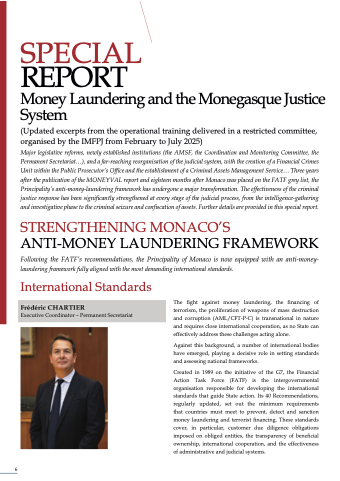
Frédéric CHARTIER
Frédéric CHARTIER
Executive Coordinator – Permanent Secretariat
Executive Coordinator – Permanent Secretariat
The fi ght against money laundering, the fi nancing of
terrorism, the proliferation of weapons of mass destruction
and corruption (AML/CFT-P-C) is transnational in nature
and requires close international cooperation, as no State can
effectively address these challenges acting alone.
Against this background, a number of international bodies
have emerged, playing a decisive role in setting standards
and assessing national frameworks.
Created in 1989 on the initiative of the G7, the Financial
Action Task Force (FATF) is the intergovernmental
organisation responsible for developing the international
standards that guide State action. Its 40 Recommendations,
regularly updated, set out the minimum requirements
that countries must meet to prevent, detect and sanction
money laundering and terrorist fi nancing. These standards
cover, in particular, customer due diligence obligations
imposed on obliged entities, the transparency of benefi cial
ownership, international cooperation, and the effectiveness
of administrative and judicial systems.
6


