


Page 6 - MONACO LAW REVIEW 2025-2
P. 6
PORTRAITS
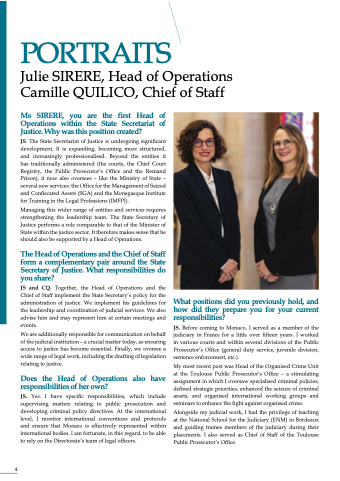
Julie SIRERE, Head of Operations
Camille QUILICO, Chief of Staff
Ms SIRERE, you are the first Head of
Operations within the State Secretariat of
Justice. Why was this position created?
JS. The State Secretariat of Justice is undergoing signifi cant
development. It is expanding, becoming more structured,
and increasingly professionalised. Beyond the entities it
has traditionally administered (the courts, the Chief Court
Registry, the Public Prosecutor’s Offi ce and the Remand
Prison), it now also oversees – like the Ministry of State –
several new services: the Offi ce for the Management of Seized
and Confi scated Assets (SGA) and the Monegasque Institute
for Training in the Legal Professions (IMFPJ).
Managing this wider range of entities and services requires
strengthening the leadership team. The State Secretary of
Justice performs a role comparable to that of the Minister of
State within the justice sector. It therefore makes sense that he
should also be supported by a Head of Operations.
The Head of Operations and the Chief of Staff
form a complementary pair around the State
Secretary of Justice. What responsibilities do
you share?
JS and CQ. Together, the Head of Operations and the
Chief of Staff implement the State Secretary’s policy for the
administration of justice. We implement his guidelines for
the leadership and coordination of judicial services. We also
advise him and may represent him at certain meetings and
events.
We are additionally responsible for communication on behalf
of the judicial institution – a crucial matter today, as ensuring
access to justice has become essential. Finally, we oversee a
wide range of legal work, including the drafting of legislation
relating to justice.
Does the Head of Operations also have
responsibilities of her own?
JS. Yes. I have specifi c responsibilities, which include
supervising matters relating to public prosecution and
developing criminal policy directives. At the international
level, I monitor international conventions and protocols
and ensure that Monaco is effectively represented within
international bodies. I am fortunate, in this regard, to be able
to rely on the Directorate’s team of legal offi cers.
What positions did you previously hold, and
how did they prepare you for your current
responsibilities?
JS. Before coming to Monaco, I served as a member of the
judiciary in France for a little over fi fteen years. I worked
in various courts and within several divisions of the Public
Prosecutor’s Offi ce (general duty service, juvenile division,
sentence enforcement, etc.).
My most recent post was Head of the Organised Crime Unit
at the Toulouse Public Prosecutor’s Offi ce – a stimulating
assignment in which I oversaw specialised criminal policies,
defi ned strategic priorities, enhanced the seizure of criminal
assets, and organised international working groups and
seminars to enhance the fi ght against organised crime.
Alongside my judicial work, I had the privilege of teaching
at the National School for the Judiciary (ENM) in Bordeaux
and guiding trainee members of the judiciary during their
placements. I also served as Chief of Staff of the Toulouse
Public Prosecutor’s Offi ce.
4


