


Page 10 - MONACO LAW REVIEW 2025-2
P. 10
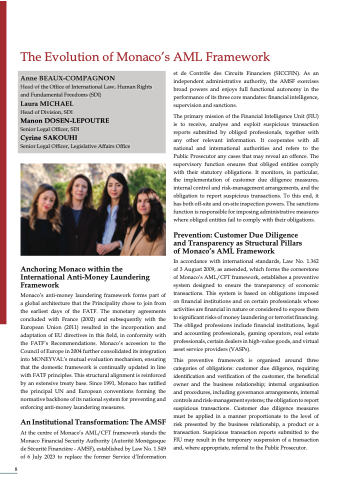
and Fundamental Freedoms (SDI)
and Fundamental Freedoms (SDI)
Laura MICHAEL
Laura MICHAEL
Head of Division, SDI
Head of Division, SDI
Manon DOSEN-LEPOUTRE
Manon DOSEN-LEPOUTRE
Senior Legal Offi cer, SDI
Senior Legal Offi cer, SDI
Cyrine SAKOUHI
Cyrine SAKOUHI
Senior Legal Offi cer, Legislative Affairs Offi ce
Senior Legal Offi cer, Legislative Affairs Offi ce
The Evolution of Monaco’s AML Framework
et de Contrôle des Circuits Financiers (SICCFIN). As an
Anne BEAUX-COMPAGNON
Anne BEAUX-COMPAGNON
. Robert BOISBOUVIER, Anne BEAUX-COMPAGNON . Robert BOISBOUVIER, Anne BEAUX-COMPAGNON
independent administrative authority, the AMSF exercises
Président Head of the Offi ce of International Law, Human Rights Président Head of the Offi ce of International Law, Human Rights
Head of the Offi ce of International Law, Human Rights
Head of the Offi ce of International Law, Human Rights
broad powers and enjoys full functional autonomy in the
performance of its three core mandates: fi nancial intelligence,
supervision and sanctions.
The primary mission of the Financial Intelligence Unit (FIU)
is to receive, analyse and exploit suspicious transaction
reports submitted by obliged professionals, together with
any other relevant information. It cooperates with all
national and international authorities and refers to the
Public Prosecutor any cases that may reveal an offence. The
supervisory function ensures that obliged entities comply
with their statutory obligations. It monitors, in particular,
the implementation of customer due diligence measures,
internal control and risk-management arrangements, and the
obligation to report suspicious transactions. To this end, it
has both off-site and on-site inspection powers. The sanctions
function is responsible for imposing administrative measures
where obliged entities fail to comply with their obligations.
Prevention: Customer Due Diligence
and Transparency as Structural Pillars
of Monaco’s AML Framework
In accordance with international standards, Law No. 1.362
of 3 August 2009, as amended, which forms the cornerstone
of Monaco’s AML/CFT framework, establishes a preventive
system designed to ensure the transparency of economic
transactions. This system is based on obligations imposed
on fi nancial institutions and on certain professionals whose
activities are fi nancial in nature or considered to expose them
to signifi cant risks of money laundering or terrorist fi nancing.
The obliged professions include fi nancial institutions, legal
and accounting professionals, gaming operators, real estate
professionals, certain dealers in high-value goods, and virtual
asset service providers (VASPs).
This preventive framework is organised around three
categories of obligations: customer due diligence, requiring
identifi cation and verifi cation of the customer, the benefi cial
owner and the business relationship; internal organisation
and procedures, including governance arrangements, internal
controls and risk-management systems; the obligation to report
suspicious transactions. Customer due diligence measures
must be applied in a manner proportionate to the level of
risk presented by the business relationship, a product or a
transaction. Suspicious transaction reports submitted to the
FIU may result in the temporary suspension of a transaction
and, where appropriate, referral to the Public Prosecutor.
Anchoring Monaco within the
International Anti-Money Laundering
Framework
Monaco’s anti-money laundering framework forms part of
a global architecture that the Principality chose to join from
the earliest days of the FATF. The monetary agreements
concluded with France (2002) and subsequently with the
European Union (2011) resulted in the incorporation and
adaptation of EU directives in this fi eld, in conformity with
the FATF’s Recommendations. Monaco’s accession to the
Council of Europe in 2004 further consolidated its integration
into MONEYVAL’s mutual evaluation mechanism, ensuring
that the domestic framework is continually updated in line
with FATF principles. This structural alignment is reinforced
by an extensive treaty base. Since 1991, Monaco has ratifi ed
the principal UN and European conventions forming the
normative backbone of its national system for preventing and
enforcing anti-money laundering measures.
An Institutional Transformation: The AMSF
At the centre of Monaco’s AML/CFT framework stands the
Monaco Financial Security Authority (Autorité Monégasque
de Sécurité Financière - AMSF), established by Law No. 1.549
of 6 July 2023 to replace the former Service d’Information
8


