


Page 30 - MONACO LAW REVIEW 2025-2
P. 30
THE IMPORTANCE
OF INTERNATIONAL
COOPERATION
Money laundering is a product of transnational crime. The
Parquet National Financier, the Guardia di Finanza and
the Spanish Ministerio Fiscal are therefore key partners in
the context of international cooperation and the exchange
of good practices.
The Parquet National
Financier
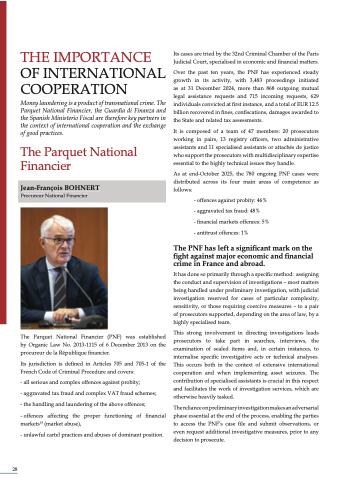
Jean-François BOHNERT
Jean-François BOHNERT
Procureur National Financier
Procureur National Financier
The Parquet National Financier (PNF) was established
by Organic Law No. 2013-1115 of 6 December 2013 on the
procureur de la République fi nancier.
Its jurisdiction is defi ned in Articles 705 and 705-1 of the
French Code of Criminal Procedure and covers:
- all serious and complex offences against probity;
- aggravated tax fraud and complex VAT fraud schemes;
- the handling and laundering of the above offences;
- offences affecting the proper functioning of fi nancial
markets18 (market abuse),
- unlawful cartel practices and abuses of dominant position.
28
Its cases are tried by the 32nd Criminal Chamber of the Paris
Judicial Court, specialised in economic and fi nancial matters.
Over the past ten years, the PNF has experienced steady
growth in its activity, with 3,483 proceedings initiated
as at 31 December 2024, more than 868 outgoing mutual
legal assistance requests and 715 incoming requests, 629
individuals convicted at fi rst instance, and a total of EUR 12.5
billion recovered in fi nes, confi scations, damages awarded to
the State and related tax assessments.
It is composed of a team of 47 members: 20 prosecutors
working in pairs, 13 registry offi cers, two administrative
assistants and 11 specialised assistants or attachés de justice
who support the prosecutors with multidisciplinary expertise
essential to the highly technical issues they handle.
As at end-October 2025, the 780 ongoing PNF cases were
distributed across its four main areas of competence as
follows:
- offences against probity: 46%
- aggravated tax fraud: 48%
- fi nancial markets offences: 5%
- antitrust offences: 1%
The PNF has left a signifi cant mark on the
fi ght against major economic and fi nancial
crime in France and abroad.
It has done so primarily through a specifi c method: assigning
the conduct and supervision of investigations – most matters
being handled under preliminary investigation, with judicial
investigation reserved for cases of particular complexity,
sensitivity, or those requiring coercive measures – to a pair
of prosecutors supported, depending on the area of law, by a
highly specialised team.
This strong involvement in directing investigations leads
prosecutors to take part in searches, interviews, the
examination of sealed items and, in certain instances, to
internalise specifi c investigative acts or technical analyses.
This occurs both in the context of extensive international
cooperation and when implementing asset seizures. The
contribution of specialised assistants is crucial in this respect
and facilitates the work of investigation services, which are
otherwise heavily tasked.
The reliance on preliminary investigation makes an adversarial
phase essential at the end of the process, enabling the parties
to access the PNF’s case fi le and submit observations, or
even request additional investigative measures, prior to any
decision to prosecute.


