


Page 24 - MONACO LAW REVIEW 2025-2
P. 24
DISSUASIVE
SANCTIONS
The recent legislative reforms have modernised Monegasque
criminal procedure and have made it possible to ensure that
sanctions are suffi ciently dissuasive in light of the threat
posed, while strengthening the effectiveness of enforcement.
Sanctions in Monegasque
Case Law
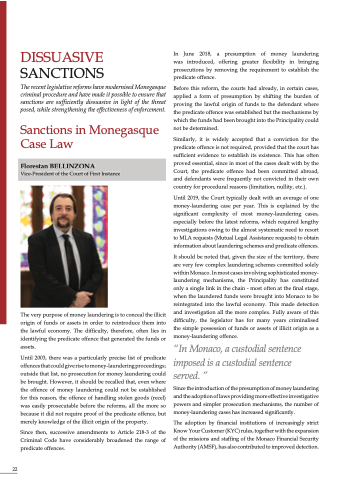
Florestan BELLINZONA
Florestan BELLINZONA
Vice-President of the Court of First Instance
Vice-President of the Court of First Instance
The very purpose of money laundering is to conceal the illicit
origin of funds or assets in order to reintroduce them into
the lawful economy. The diffi culty, therefore, often lies in
identifying the predicate offence that generated the funds or
assets.
Until 2003, there was a particularly precise list of predicate
offences that could give rise to money-laundering proceedings;
outside that list, no prosecution for money laundering could
be brought. However, it should be recalled that, even where
the offence of money laundering could not be established
for this reason, the offence of handling stolen goods (recel)
was easily prosecutable before the reforms, all the more so
because it did not require proof of the predicate offence, but
merely knowledge of the illicit origin of the property.
Since then, successive amendments to Article 218-3 of the
Criminal Code have considerably broadened the range of
predicate offences.
22
In June 2018, a presumption of money laundering
was introduced, offering greater fl exibility in bringing
prosecutions by removing the requirement to establish the
predicate offence.
Before this reform, the courts had already, in certain cases,
applied a form of presumption by shifting the burden of
proving the lawful origin of funds to the defendant where
the predicate offence was established but the mechanisms by
which the funds had been brought into the Principality could
not be determined.
Similarly, it is widely accepted that a conviction for the
predicate offence is not required, provided that the court has
suffi cient evidence to establish its existence. This has often
proved essential, since in most of the cases dealt with by the
Court, the predicate offence had been committed abroad,
and defendants were frequently not convicted in their own
country for procedural reasons (limitation, nullity, etc.).
Until 2019, the Court typically dealt with an average of one
money-laundering case per year. This is explained by the
signifi cant complexity of most money-laundering cases,
especially before the latest reforms, which required lengthy
investigations owing to the almost systematic need to resort
to MLA requests (Mutual Legal Assistance requests) to obtain
information about laundering schemes and predicate offences.
It should be noted that, given the size of the territory, there
are very few complex laundering schemes committed solely
within Monaco. In most cases involving sophisticated money-
laundering mechanisms, the Principality has constituted
only a single link in the chain - most often at the fi nal stage,
when the laundered funds were brought into Monaco to be
reintegrated into the lawful economy. This made detection
and investigation all the more complex. Fully aware of this
diffi culty, the legislator has for many years criminalised
the simple possession of funds or assets of illicit origin as a
money-laundering offence.
“In Monaco, a custodial sentence
imposed is a custodial sentence
served. ”
Since the introduction of the presumption of money laundering
and the adoption of laws providing more effective investigative
powers and simpler prosecution mechanisms, the number of
money-laundering cases has increased signifi cantly.
The adoption by fi nancial institutions of increasingly strict
Know Your Customer (KYC) rules, together with the expansion
of the missions and staffi ng of the Monaco Financial Security
Authority (AMSF), has also contributed to improved detection.


