


Page 20 - MONACO LAW REVIEW 2025-2
P. 20
EFFECTIVE ASSET
SEIZURES
Prompted by the expectations of international bodies,
Monegasque law on criminal seizures has undergone
signifi cant developments. Seizures are no longer solely
measures designed to assist in establishing the truth; they
are also instruments intended to secure the enforcement
of confi scation orders that may be issued at the end of
criminal proceedings.
Evidentiary Seizures
and Confiscation Seizures
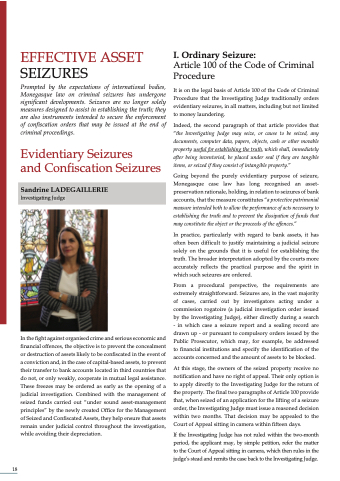
Sandrine LADEGAILLERIE
Sandrine LADEGAILLERIE
Investigating Judge
Investigating Judge
In the fi ght against organised crime and serious economic and
fi nancial offences, the objective is to prevent the concealment
or destruction of assets likely to be confi scated in the event of
a conviction and, in the case of capital-based assets, to prevent
their transfer to bank accounts located in third countries that
do not, or only weakly, cooperate in mutual legal assistance.
These freezes may be ordered as early as the opening of a
judicial investigation. Combined with the management of
seized funds carried out “under sound asset-management
principles” by the newly created Offi ce for the Management
of Seized and Confi scated Assets, they help ensure that assets
remain under judicial control throughout the investigation,
while avoiding their depreciation.
18
I. Ordinary Seizure:
Article 100 of the Code of Criminal
Procedure
It is on the legal basis of Article 100 of the Code of Criminal
Procedure that the Investigating Judge traditionally orders
evidentiary seizures, in all matters, including but not limited
to money laundering.
Indeed, the second paragraph of that article provides that
“the Investigating Judge may seize, or cause to be seized, any
documents, computer data, papers, objects, cash or other movable
property useful for establishing the truth, which shall, immediately
after being inventoried, be placed under seal if they are tangible
items, or seized if they consist of intangible property.”
Going beyond the purely evidentiary purpose of seizure,
Monegasque case law has long recognised an asset-
preservation rationale, holding, in relation to seizures of bank
accounts, that the measure constitutes “a protective patrimonial
measure intended both to allow the performance of acts necessary to
establishing the truth and to prevent the dissipation of funds that
may constitute the object or the proceeds of the offences.”
In practice, particularly with regard to bank assets, it has
often been difficult to justify maintaining a judicial seizure
solely on the grounds that it is useful for establishing the
truth. The broader interpretation adopted by the courts more
accurately reflects the practical purpose and the spirit in
which such seizures are ordered.
From a procedural perspective, the requirements are
extremely straightforward. Seizures are, in the vast majority
of cases, carried out by investigators acting under a
commission rogatoire (a judicial investigation order issued
by the Investigating Judge), either directly during a search
- in which case a seizure report and a sealing record are
drawn up - or pursuant to compulsory orders issued by the
Public Prosecutor, which may, for example, be addressed
to financial institutions and specify the identification of the
accounts concerned and the amount of assets to be blocked.
At this stage, the owners of the seized property receive no
notification and have no right of appeal. Their only option is
to apply directly to the Investigating Judge for the return of
the property. The final two paragraphs of Article 100 provide
that, when seized of an application for the lifting of a seizure
order, the Investigating Judge must issue a reasoned decision
within two months. That decision may be appealed to the
Court of Appeal sitting in camera within fifteen days.
If the Investigating Judge has not ruled within the two-month
period, the applicant may, by simple petition, refer the matter
to the Court of Appeal sitting in camera, which then rules in the
judge’s stead and remits the case back to the Investigating Judge.


